
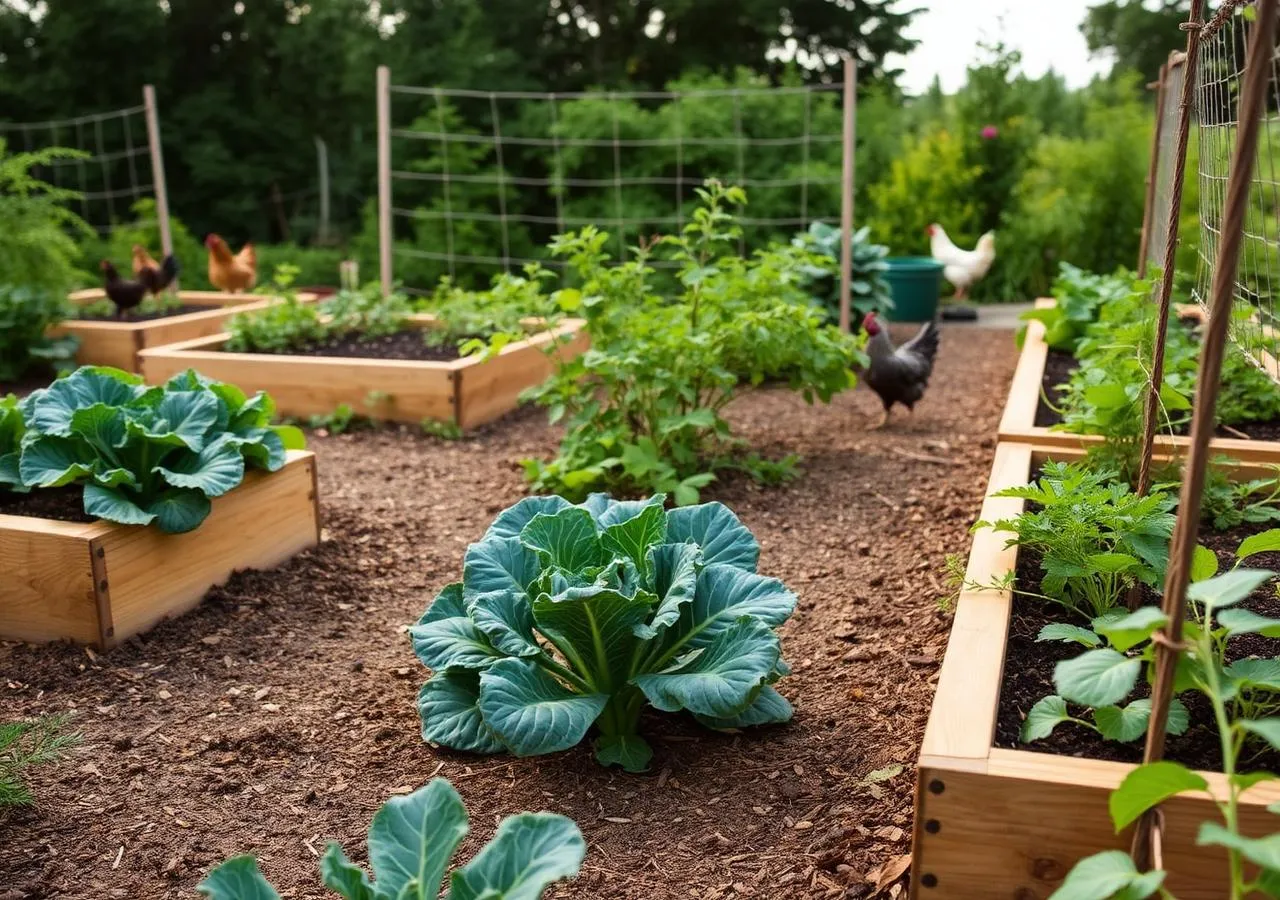
Concept image · not a photo of Joshua, Wild Mountain Farm or a customer
Food Forests
Designing a Seven-Layer Food Forest Guild for a Small Lot
A step-by-step guide: One 30-foot circle, seven layers, and a planting order that gets you fruit in year two instead of year seven.
Start my projectA food forest is not a technique, it is a shape: layers of plants occupying different heights, root depths and seasons so nothing goes unused.
Use this guild as an example planting pattern for a small lot. Adapt species, spacing and water needs to your climate; it is not a documented client or spotlight result.
Materials
- 1 semi-dwarf fruit tree
- 2 nitrogen-fixing shrubs
- 4–6 berry canes or bushes
- 10–12 perennial herbs
- Comfrey crowns, clover seed
- Wood chips, 4 in deep
Tools
- Spade
- Planting auger
- Measuring tape
- Hardware cloth for collars
- Wheelbarrow
Estimated cost: $530 per guild. Difficulty: Intermediate.
1.Map the sun and pick your center
Watch the site across a full day and place the canopy tree so its mature shadow falls north of the guild. On a small lot, one semi-dwarf tree per 30-foot circle is the right density — full standards will shade out everything you plant beneath them.
2.Place the nitrogen fixers on the drip line
Seaberry, goumi or autumn olive where legal in your state, set at the eventual drip line. They feed the tree for the first decade and get coppiced hard once the canopy closes.
3.Fill the shrub and herb layers for early yield
Currants and gooseberries on the shaded north side, raspberries on the sunny south edge, then a dense herb ring of comfrey, chives, oregano, yarrow and lemon balm. These are what feed you in years two and three.
4.Close the ground and add the vine last
White clover and strawberries as living mulch, then a hardy kiwi or grape only once the canopy tree is structurally strong — usually year four. A vine on a young tree will pull it over.
5.Mulch, collar and walk away
Four inches of wood chips over everything but the trunks, hardware-cloth collars against voles, and deep water weekly through the first two summers. After that the guild feeds itself.
Common questions
- How much space does a food forest guild need?
- One complete guild fits in about 400 square feet around a single semi-dwarf tree. You can start with one and repeat the pattern outward.
- How long before a food forest produces?
- Berries and herbs in year one to two, the canopy tree in year three to five. The system needs less work from you every year after establishment.
- Do I need to fertilize a food forest?
- Not conventionally. Nitrogen fixers and chop-and-drop mulch supply most of it once the soil biology is established, typically by year three.

Written by
Joshua Sandstrom
Joshua has spent 25+ years in permaculture and natural building and 17 in renewable energy and water systems. For the last five he's been building OASIS on 28 acres in the Appalachian mountains of Western North Carolina.
A little further in
Discover along the way
The ground beneath your plans
Your zone, frost and rainfall can change your first move.
Explore this trailA small task for this week
Check your soil moisture and note where rain collects.
Explore this trailA quick roof-water read
A planning estimate, with the assumptions shown.
Assumes 85% collection efficiency; storage and use not included.
One roof, more than one harvest
Roof → rain → tank → beds: your systems support each other.
Explore this trailLandIQ
Soil survey and drainage
Explore this trailSomething worth a closer look
How Many Chickens for a Family of 4 — Real Egg Math
Explore this trailRelated guides
Land & FoodRaised Beds
Building No-Dig Raised Beds That Last a Decade
How to Build No-Dig Raised Beds That Last 10 Years
11 minBeginner
HomeIntentional Planting
The Foundation Ring: Planting the First Ten Feet Around Your House
Foundation Planting Done Right: Moisture, Pests and Shade
7 minBeginner
Land & FoodBackyard Chickens
How Many Chickens for a Family of 4 — Real Egg Math
How Many Chickens for a Family of 4? Honest Egg and Cost Math
10 minBeginner
Your next trail
See what LandIQ finds at your place
Free newsletter
TheOASISDispatch

Seasonal ideas, practical methods and discoveries for your living system — from windowsill to acreage.
- Practical methods, with assumptions you can check
- Seasonal ideas for your next project
- Sized for your place: balcony, yard or acreage
Free · Seasonal ideas · Unsubscribe in one click