
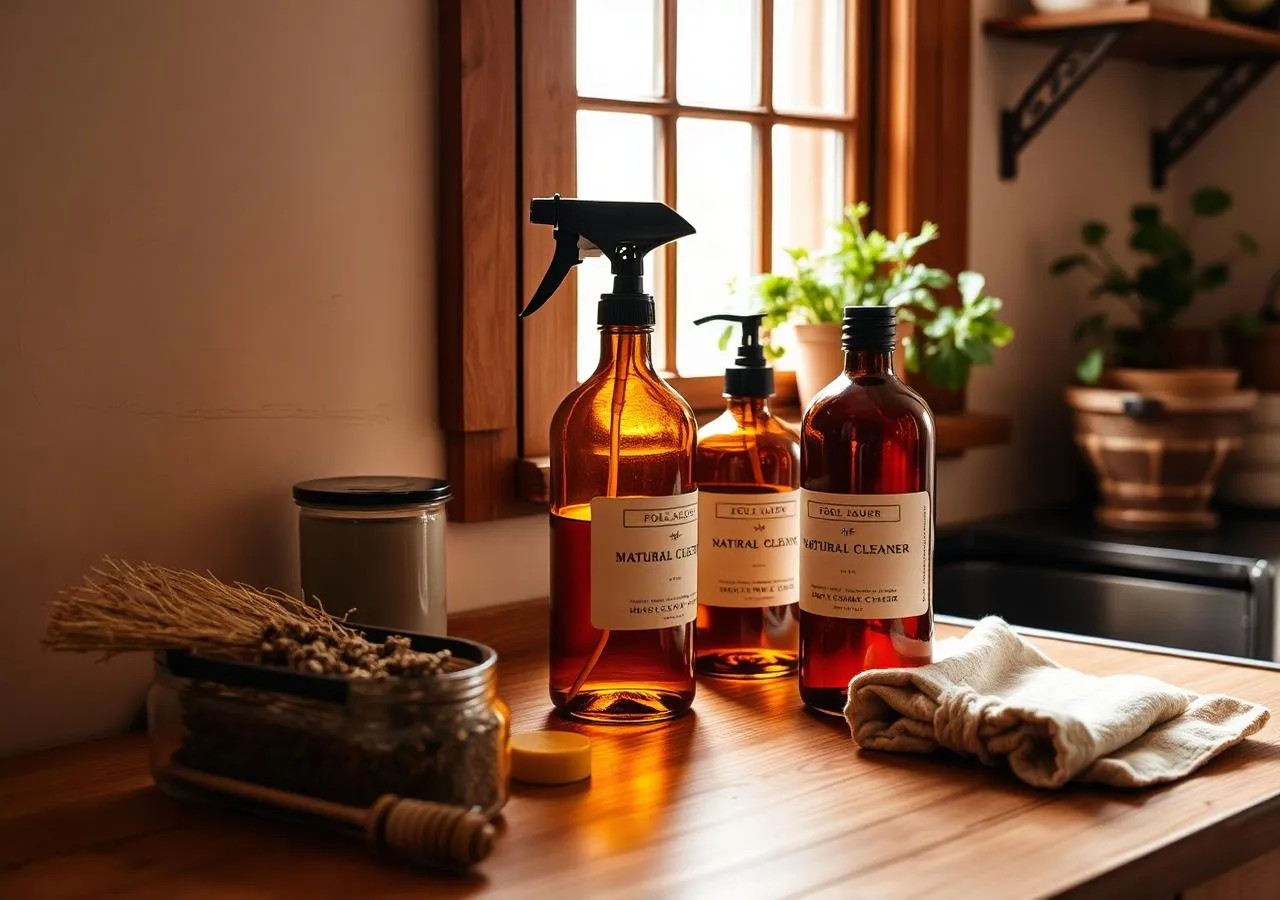
Concept image · not a photo of Joshua, Wild Mountain Farm or a customer
Natural Cleaners
Four Natural Cleaner Formulas That Replace an Entire Cabinet
A step-by-step guide: Explore surface-compatible cleaning formulas and label-led disinfection. Keep products separate and follow their instructions.
Start my projectCommercial cleaning is a marketing problem dressed as a chemistry problem. Almost every bottle under a sink is one of four things with different fragrance and a different label.
Use these formulas as starting points for suitable surfaces, with cautions about materials they can damage. Test on a small area and follow ingredient labels.
Materials
- White vinegar (5% acidity)
- Washing soda
- Liquid castile soap
- 3% hydrogen peroxide
- Citric acid
- Amber glass spray bottles
Tools
- Funnel
- Measuring spoons
- Labels
Estimated cost: $22. Difficulty: Beginner.
1.The acid: 1:1 vinegar and water
For hard-water scale, glass, chrome fixtures and the inside of a kettle. Add a tablespoon of citric acid per pint for heavy limescale. Never on natural stone, grout or unsealed wood — the acid etches all three.
2.The alkaline: 1 tbsp washing soda per quart
This is your grease cutter — range hoods, stovetops, the inside of the oven, work clothes pre-treatment. Wear gloves; washing soda is caustic enough to dry out your hands badly.
3.The solvent: 1 tsp castile soap per quart
General surfaces, floors, painted walls. Keep the concentration low — over-soaping is why homemade cleaners get a reputation for leaving film. Never mix castile soap with the vinegar bottle; you get curdled soap scum.
4.When disinfection is needed: follow a registered product label
Choose an EPA-registered disinfectant labelled for the surface and purpose. Follow its specified dilution, wet contact time, rinsing and storage instructions; concentration alone does not establish effectiveness.
Common questions
- Do homemade cleaners actually disinfect?
- Homemade cleaning mixtures should not be assumed to disinfect. Use an EPA-registered disinfectant labelled for the intended surface and purpose and follow all label directions. Vinegar is not a substitute.
- Why should I never mix vinegar and bleach?
- It releases chlorine gas. Keep acids and any chlorine product entirely apart, and never store mixed solutions in a sealed bottle.
- How long do these formulas keep?
- Mix vinegar and alcohol-based sprays in batches that last a month. Anything containing soap or plant material should be made fresh weekly.

Written by
Joshua Sandstrom
Joshua has spent 25+ years in permaculture and natural building and 17 in renewable energy and water systems. For the last five he's been building OASIS on 28 acres in the Appalachian mountains of Western North Carolina.
A little further in
Discover along the way
The ground beneath your plans
Your zone, frost and rainfall can change your first move.
Explore this trailA small task for this week
Check your soil moisture and note where rain collects.
Explore this trailA quick roof-water read
A planning estimate, with the assumptions shown.
Assumes 85% collection efficiency; storage and use not included.
One roof, more than one harvest
Roof → rain → tank → beds: your systems support each other.
Explore this trailHomeIQ
Where your household stands now
Explore this trailSomething worth a closer look
The Foundation Ring: Planting the First Ten Feet Around Your House
Explore this trailRelated guides
HomeNatural Pest Control
Excluding Mice From an Old Farmhouse Without a Single Poison Bait
How to Mouse-Proof an Old House: Exclusion Before Trapping
9 minBeginner
HomeIntentional Planting
The Foundation Ring: Planting the First Ten Feet Around Your House
Foundation Planting Done Right: Moisture, Pests and Shade
7 minBeginner
Your next trail
See what HomeIQ finds at your place
Free newsletter
TheOASISDispatch

Seasonal ideas, practical methods and discoveries for your living system — from windowsill to acreage.
- Practical methods, with assumptions you can check
- Seasonal ideas for your next project
- Sized for your place: balcony, yard or acreage
Free · Seasonal ideas · Unsubscribe in one click